The textile industry relies on a series of carefully sequenced processes to transform raw fibers into the smooth, strong yarns that eventually become the fabrics we wear every day. Among those processes, combing stands out as one of the most critical — and the machine responsible for carrying it out is simply known as the combing machine. If you have ever wondered how premium cotton shirts feel so soft or why worsted wool suits drape so cleanly, the answer very likely starts with this remarkable piece of equipment.
Understanding the Role of Combing in Textile Manufacturing
Before fiber can be spun into yarn, it must be cleaned, separated, and aligned. The early stages of this journey — opening and carding — do a reasonable job of loosening fiber clumps and removing large impurities. But carding alone leaves behind a significant amount of short fibers, seed fragments, neps (tiny knots of tangled fiber), and other fine trash that would compromise the final yarn’s quality.
This is precisely where the combing machine steps in. Its job is to perform a deeper, more precise level of fiber preparation. It grips fiber bundles at both ends and draws a fine-toothed comb through them, removing everything shorter than a predetermined length threshold while simultaneously straightening and parallelizing the remaining long fibers. The result is a clean, organized fiber bundle known as a combed sliver — the foundation of high-quality yarn.
Key Functions of a Combing Machine
A combing machine performs several important functions simultaneously during operation:
• Short fiber elimination: Fibers below a set length (typically under 16 mm for cotton) are combed out and collected as combing noil, a byproduct used in lower-grade products.
• Nep and impurity removal: Neps, vegetable matter, seed coat fragments, and other micro-contaminants are extracted from the fiber bundle.
• Fiber alignment: Long fibers are straightened and made parallel to one another, which dramatically improves yarn evenness and tensile strength.
• Sliver formation: The clean, aligned fibers are gathered and formed into a uniform combed sliver ready for the drawing frame.
Types of Combing Machines
The textile industry uses two broad structural types of combing machines: the straight comber and the circular comber. The straight comber is by far the more widely used design in modern mills. It operates on an intermittent, periodic basis — the fiber bundle is held, combed, and then released in a rhythmic cycle. This design is particularly effective for processing fine, short-to-medium staple fibers such as cotton and certain wools.
The circular comber, by contrast, operates more continuously and is suited to longer-staple fibers. While less common in general cotton processing, it finds application in specialty fiber industries.
A third category has grown increasingly important for research and quality control environments: the laboratory combing machine. These compact, bench-scale machines replicate the full combing process in miniature form, enabling researchers, universities, and small mills to test fiber lots, develop new yarn formulations, and train technicians without tying up production-scale equipment.
How the Combing Process Works Step by Step
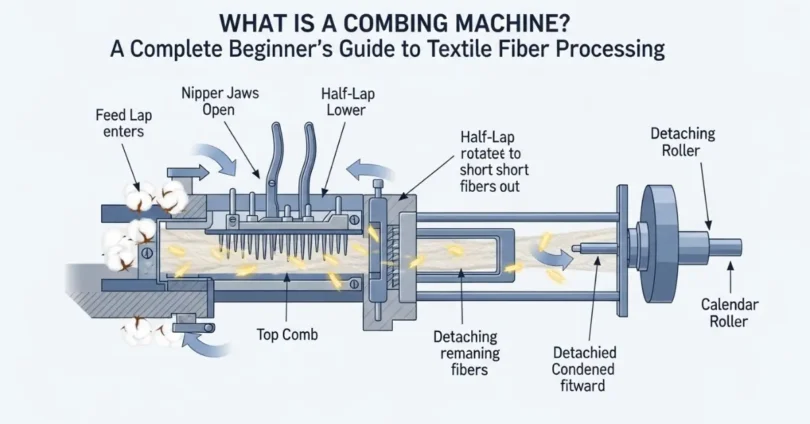
Understanding the working cycle of a straight comber helps illustrate just how precise this process is. The machine feeds a prepared lap (a thin, uniform sheet of fiber) into a nipper assembly — two plates that clamp the fiber bundle firmly. With the back end gripped, a rotating cylinder covered in fine needles combs through the protruding front end of the fiber tuft, removing short fibers and impurities.
The nipper then releases the fiber and moves it forward. The detaching rollers grip the combed front end and pull it away, passing it through a top comb that combs the tail end of the departing tuft. The small sections of fiber are pieced together (a process called lapping) to form a continuous web, which is then condensed into a sliver and coiled into a can for the next stage of processing.
Modern machines run this cycle many times per minute and incorporate programmable logic controllers (PLCs), touch screens, and frequency converters to maintain precise settings and consistent output.
Why Combing Matters for Yarn and Fabric Quality
The difference between combed and carded yarn is tangible. Combed yarn is stronger, smoother, and more uniform because it contains only the longest, best-aligned fibers. Fabrics woven or knitted from combed yarns have better luster, less pilling, and a finer hand feel. This is why combed cotton is the preferred raw material for fine shirting, premium knitwear, and luxury bedding.
In the worsted wool system, combing is equally essential. The process removes short wool fibers (called noil), leaving behind a parallel fiber bundle called top, which is then drawn and spun into the smooth, resilient worsted yarns used in tailored clothing.
Laboratory Combing Machines: Small Scale, Big Impact
For institutions and businesses that need the combing process without full industrial scale, laboratory combing machines offer a practical solution. Products like the Lab Combing Machine DW7011H from FYI Tester bring the core functions of a production comber into a compact, easy-to-operate format. Featuring PLC control, a touch screen interface, and a mini-type design that simplifies cleaning and maintenance, these machines are well suited to textile research labs, universities, and fiber development programs.
Whether you are testing a new cotton variety, training students in fiber processing, or developing a prototype yarn formula, a laboratory combing machine gives you accurate, repeatable results at a fraction of the footprint of an industrial comber.
Final Thoughts
The combing machine may not be the most glamorous piece of equipment in a textile mill, but it is one of the most consequential. By removing short fibers, eliminating impurities, and aligning long fibers into a clean, parallel sliver, it sets the stage for every quality advantage that follows in the spinning process. Understanding what a combing machine does and how it works is foundational knowledge for anyone involved in fiber, yarn, or fabric production.